
DRAFT 1.1 • LATER STATE TRACK • Audience: policymakers, state leaders, school boards
Stop piling programs on. Reset what schools must accomplish.
This is the later state track: a proposed transition for changing Minnesota’s governing framework after the core model has been debated, tested, and refined. The goal is not another layer of programs. It is to reset the state architecture around clear mastery, local curriculum authority, student intellectual freedom, curriculum transparency, honest accounting for instructional time, and visible student outcomes.
What changes first
State policy should first define what schools are expected to accomplish, what students must demonstrate, what protections students retain, and what decisions belong locally. Only after that should Minnesota rewrite standards, graduation expectations, accountability, and individual mandates around the new structure.
Related definitions: Age-Appropriate Standards, Student Intellectual Freedom, and Civic Mechanics.
State actions in the later track
- Rewrite the statutory mission. Put literacy, numeracy, communication, science, broad knowledge, logic, practical competence, and independent adulthood at the center.
- Review conflicting statewide mandates. Preserve accurate teaching of difficult and controversial subjects while separating required student outcomes from prescribed interpretive or political methods.
- Authorize standards replacement. Build measurable standards around a stable Grade → Strand → Anchor → Benchmark architecture.
- Implement K–5 first. Protect structured reading instruction, mathematics, writing, science, geography, broad knowledge, curiosity, art, music, play, and age-appropriate learning.
- Protect student intellectual freedom. Permit rigorous study of contested ideas while barring compelled belief, political organizing, or unnecessary sensitive self-disclosure as conditions of academic credit.
- Make Grades 6–8 the reasoning years. Emphasize algebra, experiments, writing, statistics, coding, source evaluation, practical math, and civic mechanics.
- Rebuild high school around adulthood and specialization. Use the proposed 24-credit framework, advanced pathways, comparative study of major political and economic systems, and practical competence while treating Run Your Life as a pilot capstone.
- Restore meaningful local curriculum control. State sets measurable outcomes; districts and communities choose most methods, texts, materials, and sequencing.
- Make curriculum visible and reviewable. Require reasonable access to major texts, media, assignments, rubrics, outside instructional materials, and policies involving advocacy or sensitive personal disclosure, plus a defined challenge process.
- Adopt a mandate test. Use the Instructional Mandate Review for competency, evidence, age, time, cost, displaced instruction, assessment, local authority, and review date.
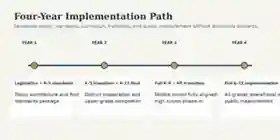
Illustrative four-year transition
This is a sequencing concept, not enacted law.
| Year | Primary action |
|---|---|
| Year 1 | Pass reset legislation; establish mandate, transparency, intellectual-freedom, and developmental review rules; draft K–5 replacement standards. |
| Year 2 | Begin K–5 transition and finalize Grades 6–12 standards. |
| Year 3 | Full K–8 implementation and high-school transition. |
| Year 4 | Full K–12 implementation with public outcome review. |
Curriculum transparency and challenge process
A district operating under this draft framework should provide reasonable access to required standards, major texts and media, recurring outside lesson materials, required student tasks, grading rubrics, and policies governing advocacy, organizing, or sensitive personal disclosure. A parent, student, teacher, or resident should be able to raise a concern using the academic, developmental, intellectual-freedom, or local-authority standards.
The preferred remedy is correction, clarification, a compliant alternative assignment where appropriate, or revised materials. The process should not presume teacher misconduct or remove legitimate historical content simply because a topic is controversial.
Technical policy relationship
The later state track operationalizes Policy Standards Draft 1.1. Model legislation would need separate drafting, legal review, fiscal analysis, and version control. This page does not itself have statutory force.

