
GRADES 9–12 • PREPARE FOR INDEPENDENCE • DRAFT
High school should prepare students to operate independently.
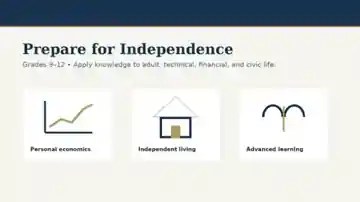
The Minnesota Learning Project combines rigorous academics with adult competencies every graduate will use regardless of college, trade, employment, military, entrepreneurship, or another path.
Explore the grades
Each grade progressively moves students from advanced academic reasoning toward financial, civic, technical, and household independence.
GRADE 9
Foundations of Adult Thinking
Complex reading, professional writing, algebra, physical science, formal logic, source reliability, probability, rhetoric, and digital information.
GRADE 10
Civilization, Biology & Making
World civilization, biology, sustained writing, advanced mathematics, engineering or technical projects, and substantial hands-on making.
GRADE 11
Economic Independence
Payroll, taxes, banking, credit, investing, retirement, statistics and risk, public institutions, budgets, and career exploration.
GRADE 12
Independent Adult Life
Housing, insurance, vehicles, healthcare, employment, household management, first aid, contracts, business, and local government.
Proposed 24-credit framework
| Literacy & Communication | 4 | Science & Engineering | 3 |
| Mathematics & Quantitative Reasoning | 4 | History, Geography & Civic Mechanics | 2 |
| Logic, Research & Information | 1 | Personal Economics & Independent Living | 2 |
| Technology, Trades & Career Preparation | 2 | Health & Nutrition | 1 |
| Physical Education | 1 | Arts | 1 |
| Advanced Pathway / Electives | 3 | Total | 24 |
Three sample four-year schedules
These are examples, not required course titles. Districts could package the competencies differently as long as students reach the common outcomes.
1. College-preparation path
| Grade 9 | Grade 10 | Grade 11 | Grade 12 |
|---|---|---|---|
| English 9 Algebra I / Geometry Physical Science World History Health / PE World Language Arts or elective | English 10 Geometry / Algebra II Biology World Civilization / Civics World Language Technology / Making Elective | English 11 Algebra II / Precalculus Chemistry or Physics U.S. History / Government Personal Economics Advanced elective Arts / PE if needed | English 12 Precalculus / Calculus / Statistics Advanced Science Logic / Research seminar Independent Living 2 pathway electives Capstone or internship elective |
Double-counting: a statistics course can satisfy quantitative reasoning while serving a science or research pathway; a research seminar can combine writing, logic, and information literacy; a civics course can include substantial writing without replacing the full literacy requirement.
2. Skilled-trades path
| Grade 9 | Grade 10 | Grade 11 | Grade 12 |
|---|---|---|---|
| English 9 Algebra I Physical Science World History Health / PE Intro to Trades / Shop Arts or elective | English 10 Geometry Biology Civics / Geography Technical Drawing / CAD Trades Lab I Elective | English 11 Applied Algebra / Statistics Applied Physics Personal Economics Trades Lab II Workplace Safety / Technical Writing Apprenticeship or elective | English 12 Applied Math for Trades Government / Local Institutions Independent Living Trades Lab III Work-based learning Industry credential or apprenticeship block |
Double-counting: technical writing can satisfy part of literacy and career preparation; applied physics can satisfy science while supporting the trades pathway; a supervised work-based program can count toward career preparation and advanced pathway credit if it includes documented competencies.
3. Student entering Grade 9 roughly two years behind
| Grade 9 | Grade 10 | Grade 11 | Grade 12 |
|---|---|---|---|
| Double-period Literacy Lab + English Foundations Math + Algebra support Integrated Science World History Health / PE Career exploration | English 10 + targeted literacy support Algebra I / Geometry support Biology Civics / Geography Technology / Trades Personal Economics I | English 11 Geometry / Applied Algebra Science U.S. History / Government Personal Economics II Career / trades pathway Targeted intervention as needed | English 12 Quantitative Reasoning / Statistics Independent Living Government / Civic Mechanics Career pathway / work-based learning Science or pathway completion Recovery block for any unfinished mastery |
What gets cut first: when the day is overloaded, reduce low-priority electives, duplicate survey courses, and nonessential standalone requirements before cutting literacy, mathematics, science, or the support block needed to close foundational gaps. Arts, health, and physical education remain part of the framework, but may be scheduled in concentrated blocks or integrated where legitimate competencies overlap.
Tradeoffs when the school day cannot hold everything
A curriculum cannot expand forever without displacing something else. The proposal therefore favors three rules: protect literacy and quantitative competence; allow a course or project to count toward more than one requirement when it genuinely demonstrates both sets of competencies; and require any new statewide mandate to identify the time it consumes and the instruction it displaces. “More requirements” is not automatically “more learning.”
Advanced pathways
Students can specialize in Engineering & Technology, Medical & Life Sciences, Skilled Trades, Business & Entrepreneurship, Humanities, or Arts. The common foundation should enable specialization, not suppress it.
Study political and economic systems comparatively
High school should not shield students from controversial ideas. Students should compare major political and economic systems using primary texts, institutional design, incentives, historical examples, stated ideals, civil-liberty consequences, and observed outcomes. The academic task is to understand and evaluate competing systems—not to require allegiance to one. See Student Intellectual Freedom.
Run Your Life is a pilot capstone, not the diploma.
Run Your Life is presented on its own page as a pilot model for testing practical adult competence. It is not currently a graduation requirement, is not the diploma, and should not become a high-stakes condition for graduation until the model has been specified, piloted, tested for reliability and accessibility, and formally adopted through the appropriate public process.

